Why my approach is different to generic low back pain rehab
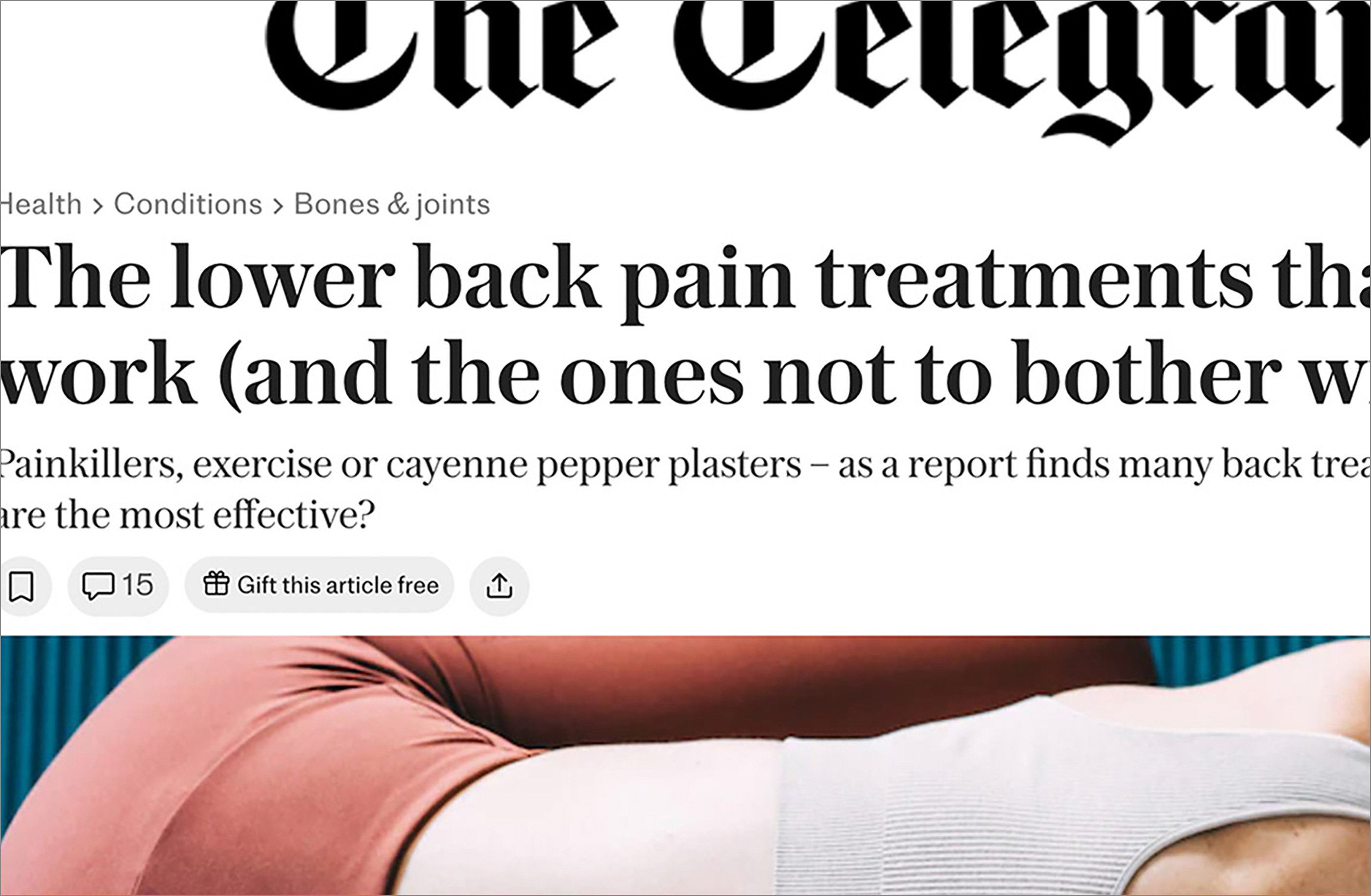
Last year, I was featured in an article, 'Lower back pain treatments that work', in The Telegraph (UK). I was asked to comment on the recent, largest study of its kind that concluded that 90% of low back pain treatments don't work.
I said that the results were entirely predictable.
The problem with studies like these is that they lump all cases of low back pain into the same category of 'non-specific low back pain'. They then compare how effective different treatments are at resolving these cases, without sub-categorising them. Predictably, due to the lack of individualisation, the treatments are hit and miss. They help some people, do nothing for others, and make some people's pain worse.
A common example of this is when typical low back pain mobility exercises are given to someone who requires more stability (not mobility) for their back to heal. The mobility work keeps them in a cycle of pain, not because their back is irreparable, but because they've been given inappropriate exercises for their individual situation.
This happens because they haven't been adequately assessed to establish what their individual pain triggers are.
Long term success requires a personalised assessment and rehab plan that deals with the root cause of your pain instead of just randomly targeting your symptoms.
This is the essence of The McGill Method, developed by world-renowned low back pain expert, Professor Stuart McGill. The McGill Method assessment is the starting point of my approach (outlined below) for all of my new clients:
1. a MCGILL METHOD ASSESSMENT
This involves the following:
- A detailed personal history: too often, important details that are essential to understanding someone's pain are skipped over. This may be an accident involving traumatic impact that you had when you were younger; your ability to contort your joints into unusual positions; or in Daniel's case - an operation he had when he was a baby. Lifestyle and psychological factors are also taken into account.
- Provocative pain testing: understanding your individual pain triggers is essential before designing your personalised rehabilitation program. For example, many typical low back pain programs assume that your spine is tolerant of flexion, extension, rotation and compression. However, in reality, this is often not the case. We need to know this and design your program around your intolerances accordingly.
- Identification of any movement restrictions you have: If you have restricted hip, ankle or shoulder mobility, this often also needs to be addressed because it affects how much stress you direct through your spine.
- Clarification of how your pain triggers relate to your imaging (e.g. MRI): Your MRI is a snapshot of your spine in one fixed position at one moment in time. This can often show important details but it's only part of the big picture because it doesn't show how your spine behaves dynamically. A biomechanical assessment is necessary for this. Sometimes it will reveal that abnormalities visible on your MRI are unlikely to be your current source of pain.
- Spine hygiene: this involves learning how to move in a way that doesn't provoke your pain triggers. You'll learn movement strategies such as bracing and hip hingeing that reduce the stress transmitted through the damaged tissues in your spine, ultimately, allowing it to heal.
- A personalised exercise program: this is based on the results of your assessment and in the initial stages is designed to address deficits in stability, mobility and muscular endurance (strength and power are addressed later, once an initial base has been developed).
- Coaching of the exercises: a key part of the assessment session is the coaching of correct exercise technique. If you don't execute the exercises with good form, you're likely to ingrain suboptimal movement patterns that can end up exacerbating your pain and prevent your spine from healing itself.
2. a DETAILED WRITTEN REPORT
This has three purposes:
- To help you understand your low back pain (and help you remember important details)
- To facilitate communication with your doctor regarding the assessment findings
- To serve as a detailed reference that helps me to help you moving forward. This last point is essential - it's a mistake to assume that your clinician remembers every detail of your case. Without a detailed report, important details can easily be forgotten which can lead to bad decisions in progressing your recovery plan, and, as a consequence, unnecessary setbacks.
3. CONTINUED SUPPORT
Your personalised training program with videos of all of your exercises is delivered to you via the True Coach app. If you have any questions or doubts about anything in between sessions you can contact me via the app. You can also upload videos via the app so I can check your technique.
If you have any unexpected setbacks, I will adjust your program accordingly - it's nearly always possible to work around these.
4. CONSISTENT FOLLOW-UP SESSIONS
All of your follow-up sessions will be with me. Having the same person deal with you throughout your recovery ensures important details aren't forgotten and that your program is progressed appropriately and consistently.
Not only will you be dealing exclusively with me, but I take the time to consult my detailed case notes before each session so we can make the most of your time.
5. TOOLS THAT LAST YOU A LIFETIME
Your low back pain did not spontaneously arise for no reason. It usually occurs after decades of sub-optimal movement patterns, poor postures and exposure to loads that exceed the capacity of your spine.
It's true that genetics play a role and may be responsible for 'loading the gun'. But it's behaviour and movement (or lack of it) that 'pull the trigger'.
Learning how to move in a way that reduces the stress on the passive tissues of your spine (your discs, ligaments, vertebrae, etc), while strengthening the active tissues that control it (your muscles) is essential if you want to maintain good spine health for the rest of your life.
The first step is a McGill Method assessment.
A CHECKLIST TO DETERMINE WHETHER MY APPROACH IS RIGHT FOR YOU
If any of the following apply to you, then we're not a good fit to work together at this moment in time:
- You have red-flag symptoms (saddle anaesthesia, loss of bladder/bowel control, constant night pain, recent major trauma).
-> You need urgent medical care, not coaching. - You expect someone to fix you, either by 'cracking you back into place' or applying passive treatments (e.g. ultrasound, TENS, dry needling) to you while you lie motionless.
-> Learning how to move in a way that addresses the root cause of your pain should be the priority if you want a long term solution to your low back pain. Passive treatments create dependency and do nothing to protect you against future flare-ups. - You’re unwilling to change your daily movement habits or activities even when they provoke your pain.
-> Eliminating your pain triggers is the most important component of a successful rehab program. No amount of exercise or any other intervention is a substitute for this. - You're unwilling to address your weaknesses or movement restrictions by doing 10-30 minutes of targeted rehab (excluding walking) most days.
-> The program is different for everyone but always requires commitment to movement. - Your pain does NOT change at all when you move or change posture.
-> You should see your medical doctor to rule out anything sinister before working with me.