Featured in:






Description: Physio, chiro, injections, surgery or McGill Method assessment & coaching? A complete guide to which back pain treatment in Dubai suits your situation, and when.
Author: Andy Marlow, McGill Method Certified Provider since 2019, coaching since 2010. Last updated November 2026.
If you’re in Dubai and your low back pain keeps coming back, or has never fully gone away, the right next step depends on three things: whether you have any “red flag” warning signs that need a doctor’s attention, how long you’ve had the pain, and whether anyone has ever identified the specific movements, postures and loads that trigger it.
For most people with persistent back pain and no warning signs, the most sensible starting point is the most conservative one: finding and removing those pain triggers before considering injections or surgery.
This guide explains the main options available in Dubai, from GPs and hospital spine clinics to physiotherapy, chiropractic and McGill Method coaching, including who each one suits, when it makes sense and what its limitations are.
Most low back pain isn’t caused by anything serious. But if you have back pain with any of the following, get a medical assessment today:
If you have any of the symptoms in the first point, go straight to an emergency department or call 998. If none of these apply, read on.
If you’ve already tried several treatments and your pain keeps coming back, you’re far from alone. A large study widely reported in the press concluded that around 90% of low back pain treatments don’t work. As I explained when I was interviewed for an article in The Telegraph, I think that result was predictable, because studies like this put everyone into a single category of “non-specific low back pain,” as if every back hurt for the same reason. In my experience, there are a few common reasons treatments fail.
The diagnosis rarely pins down the cause. Most people with persistent back pain are given a general label, such as “non-specific low back pain,” “muscle strain” or “disc degeneration.” But there’s no such thing as non-specific back pain, any more than there’s non-specific knee pain. One of my clients had limited ankle mobility after an operation for a club foot, so he’d spent his life bending through his spine whenever he picked something up, which eventually led to a herniated disc. Improving his ankle mobility was a key part of his rehab. No generic back treatment would have found that.
Treatment targets symptoms, not triggers. Massage, manipulation, heat, painkillers and injections can all make pain feel better for a while. But if you go back to the same way of sitting at your desk, bending to pick things up or training at the gym that was irritating your back, the pain comes back. Pain relief without removing the offending pain triggers isn't a long-term solution.
Generic programs don’t fit individual backs. Stretching routines, core programs and Pilates help some people and aggravate others. A movement that’s helpful for one back can be the trigger for another, which is why a program that worked for a colleague may not work for you.
Scans can point in the wrong direction. Many findings on an MRI, such as disc bulges and degeneration, are common in people with no pain at all. Treatment aimed at what shows up on a scan may miss what’s actually causing your pain.
Stress and lifestyle matter, but aren’t always the cause. Poor sleep, work pressure and worry about your back can all make pain worse and recovery slower, and a good practitioner will take them into account. But their presence doesn’t automatically make them the main driver. If your pain is set off by specific movements and postures, managing stress alone won’t solve it.
What lasting improvement usually depends on is a thorough assessment to identify what specifically provokes your pain, then removing or modifying those triggers and gradually building your back’s tolerance. That takes time and skill, which is why it rarely fits into short appointments. Keep it in mind as you read on, and ask any practitioner you’re considering how they’ll identify your specific pain triggers and teach you how to avoid provoking them.
Read more: Featured in the Telegraph: Lower back pain treatments that work
The first professional you see has a big influence on the treatment you end up receiving. In a study of nearly 1,900 workers with back injuries in the US, about 43% of those who first saw a surgeon went on to have surgery within three years, compared with under 2% of those who first saw a chiropractor. The link remained strong even after accounting for how severe their injuries were (Keeney et al., Spine, 2013).
Other research has found that the tests you’re sent for depend heavily on which specialist you see, not just on your symptoms (Cherkin et al., 1994), and that people who see a physiotherapist first are less likely to be prescribed opioids or sent for scans (Frogner et al., 2018).
This doesn’t mean any one profession is right or wrong. People with more severe problems may go to a surgeon first, and studies like these can’t fully separate cause from effect. But it does mean every professional tends to see your back through the lens of what they do, and that includes me.
My starting point is identifying the specific movements, postures and loads that trigger your pain. I also take stress, sleep, work, lifestyle and how you feel about your pain into account, but I don’t automatically assume they’re the cause just because they’re present.
In my view, finding and removing your pain triggers is the most conservative approach there is. Unless there’s a medical reason to act quickly, it should be tried before more invasive options such as injections or surgery. And when something else is the better option, I refer people on. I’ve referred clients to surgeons, chiropractors and Schroth practitioners when it was the more appropriate course of action.
Here’s an overview of the different options you have in Dubai when you have low back pain.
What it is
A GP or family medicine doctor is usually the first medical professional you’ll see about back pain. A sports medicine doctor specialises in muscles, joints and injuries, and can be a good fit if you’re active. Either can take your history, examine you, check for anything serious, prescribe short-term pain relief and refer you on for imaging, physiotherapy or a specialist opinion.
Who it suits
Anyone with a new episode of back pain or who has never had their back checked by a doctor, anyone with any of the red flag warning signs listed above, and anyone whose pain doesn’t follow a typical pattern and needs a serious cause ruled out.
When it makes sense
At the start of a new or different kind of back pain, or when your symptoms change, for example pain spreading down your leg, or numbness, tingling or weakness that’s getting worse. It’s also the right call if you need medication to get through a bad flare-up, or if your insurance requires a referral before you see a specialist or physio.
Its limitations
A GP’s role is to rule out serious causes, manage symptoms and point you in the right direction, and they’re well placed to do that. What general practice isn’t designed for is the detailed assessment needed to identify which specific movements, postures and loads set off your pain, and how your personal history (old injuries, sports, work habits) contributes to it. That takes a specialised skill set and far more time than a typical appointment allows. So for persistent pain, advice often ends up general: rest, painkillers, stay active, see a physio. Medication can make a flare-up bearable, but it doesn’t change what keeps triggering the pain.
What to ask
What it is
Many of Dubai’s major hospitals have a dedicated spine or back pain clinic. These typically bring together orthopaedic spine surgeons, neurosurgeons, pain management specialists and physiotherapists, with MRI and other imaging on site. They can investigate your back in depth and offer everything from medication and physio to injections and surgery.
Who it suits
People with significant or worsening nerve symptoms, such as leg weakness, spreading numbness or severe sciatica that isn’t settling. Also people for whom a serious cause needs to be ruled out, and people already considering injections or surgery who want a specialist opinion.
When it makes sense
When any of the red flag warning signs apply, when nerve symptoms are getting worse rather than better, or when you’ve followed a thorough conservative plan without meaningful progress. (See surgery, below, for more on timing.)
Its limitations
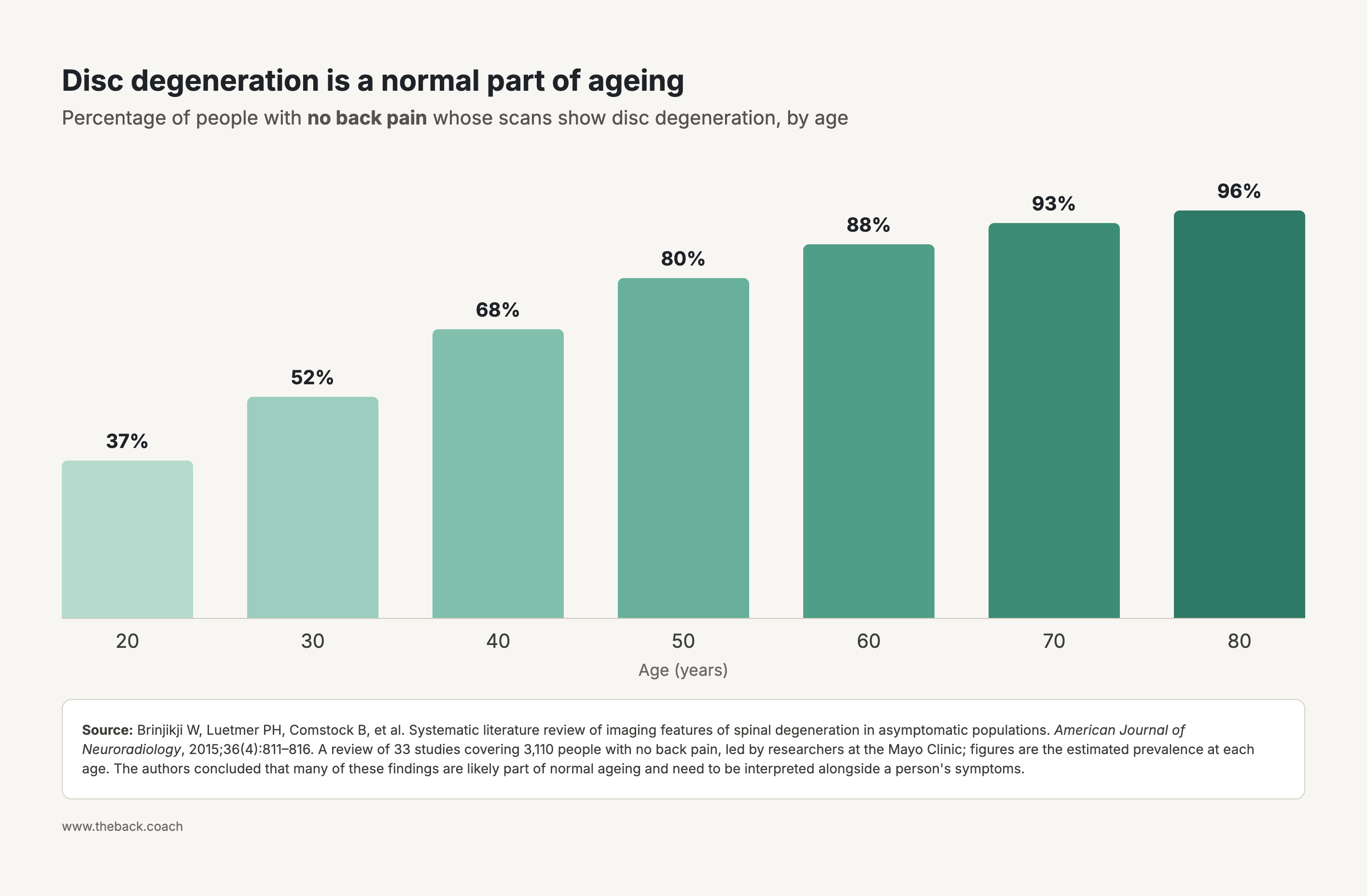
An MRI is excellent at detecting things like nerve compression, fractures, infection or tumours. It’s much less reliable at telling you why your back hurts. Findings that sound alarming are very common in people with no pain at all. A large review of pain-free people (Brinjikji et al., 2015) found that disc degeneration showed up in 37% of 20-year-olds, rising to 96% of 80-year-olds, while disc bulges went from 30% at age 20 to 84% at age 80. These findings are somewhat more common in people with back pain, so they’re certainly not meaningless. But a scan on its own can’t tell you whether a particular finding is causing your pain, or which movements make it worse. That’s why guidelines for doctors advise against routine imaging for non-specific low back pain.
The other limitation is where hospital care tends to lead. Spine clinics are set up for diagnosis and procedures, so a scan finding can move you quickly towards injections or surgery, sometimes before a thorough conservative plan has been tried.
What to ask
Read more: When your MRI doesn’t tell the full story
What it is
Physiotherapists are licensed health professionals who assess and treat musculoskeletal problems. Treatment for back pain usually combines exercise and hands-on treatments, sometimes with machines such as ultrasound, TENS or shockwave. Quality varies more than most people expect: two physios can take completely different approaches to the same back.
Who it suits
Almost everyone with back pain can benefit from a good physio at some point. It’s particularly useful early on, for rehab after surgery, and for people whose insurance covers a set number of sessions.
When it makes sense
Once a doctor has ruled out anything serious, or straight away for straightforward back pain with no warning signs. It’s most likely to help when the physio has time to assess you properly and you see the same person each time.
Its limitations
Good physiotherapy can be very effective. The problem is that quality and approach vary a great deal, and the way care is often delivered limits what’s possible.
In busy clinics, sessions can be short, which leaves little time for a detailed assessment. Some clinics still rely heavily on passive treatments like ultrasound and TENS, which the UK’s NICE guideline lists among treatments not to offer for low back pain. Generic exercise sheets often don’t take account of which movements aggravate your back.
Much of modern physiotherapy is built on the biopsychosocial model, which recognises that pain is shaped by beliefs, stress and fear as well as by the body. The best-known evidence for it is the RESTORE trial, which found that cognitive functional therapy, an individualised approach targeting both how people think about and move with their pain, produced large and lasting improvements at considerably lower cost than usual care.
But the trial has important limitations. It compared the therapy with usual care rather than with another individualised, active approach, so it shows the therapy was better than what people would otherwise have received, not that it was better than other personalised plans. And because the therapy combined changing people’s beliefs with changing how they moved, the trial can’t show which part made the difference. It certainly doesn’t show that addressing beliefs and fears alone is enough.
That’s where I think the biopsychosocial approach can fall short in practice. If you’re reassured that movement is safe and encouraged to do more, but no one has identified which specific movements, postures and loads provoke your pain, you may keep aggravating it.
What to look for
A good physio will take a detailed history, including what you’ve already tried. They’ll test which movements, postures and loads provoke your pain and which relieve it. They’ll educate you about your pain and give you a clear plan to carry out yourself between sessions. They won’t rely on passive treatment where you lie motionless on a table, and they’ll measure your progress and change course if you’re not improving.
What to ask
Read more: When rehab makes your back worse
What it is
Chiropractors assess and treat muscle and joint problems, often using spinal manipulation: a quick, controlled thrust to a joint that often produces a popping sound. Many also use mobilisation, soft tissue techniques and exercise. Approaches vary widely, from practitioners who combine manipulation with a clear rehab plan to clinics built around regular, ongoing “maintenance” adjustments.
Who it suits
People who want short-term relief from pain and stiffness, particularly if they’ve responded well to manipulation before, and who are willing to combine it with an active plan.
When it makes sense
As a short course to ease pain enough for you to move more comfortably and start building your back’s tolerance.
Its limitations
Relief from manipulation is often temporary, and the popping sound doesn’t mean anything has been “put back into place.” On its own, manipulation doesn’t identify or remove what’s triggering your pain. The UK’s NICE guideline reflects this: it advises considering manual therapy, including spinal manipulation, mobilisation and massage, but only as part of a treatment package that includes exercise. Be cautious of clinics that recommend routine X-rays for everyone, don't provide you with a personalised exercise plan, or suggest you’ll need adjustments indefinitely.
What to ask
Read more: Should You See a Chiropractor for Your Low Back Pain?
What it is
Hands-on work on muscles and soft tissue. In Dubai this ranges from relaxation massage at hotels and spas to sports or remedial massage aimed at specific problem areas.
Who it suits
People looking for short-term relief and relaxation, and people with tightness in their hips, glutes, upper back or shoulders. Freeing up those areas can reduce the load on the lower back during everyday movements.
When it makes sense
Alongside an active plan, between flare-ups, or as a way to manage stress, which can make pain worse.
Its limitations
Relief is usually short-lived. In my experience, a tight lower back is often tight for a reason: the muscles are protecting an irritated area. Deep pressure directly on it may feel good on the table, but it can leave the area more sensitive afterwards and doesn’t address why the muscles are guarding in the first place. Like other manual therapies, NICE recommends massage only as part of a package that includes exercise, and on its own it won’t identify what’s triggering your pain.
What to ask or look for
What it is
Exercise classes or private sessions focused on control, flexibility and strength. Reformer Pilates studios and yoga classes are hugely popular in Dubai, alongside gym-based core classes and online programs.
Who it suits
People whose back pain is mild or has settled, who enjoy this kind of exercise, and who know which movements they need to avoid or modify. It can be a good way to stay active and build confidence.
When it makes sense
Once you know what triggers your pain, and with an instructor who understands back pain and is willing to adapt exercises for you. Starting with private sessions before joining group classes is usually wise.
Its limitations
Exercise in general is good for back pain. NICE recommends considering group exercise programmes, including mind–body approaches, while taking people’s specific needs, preferences and capabilities into account when choosing the type of exercise. That last part is the problem with many classes. Generic sequences often include repeated bending and twisting of the spine, such as roll-ups, roll-downs, forward folds and crunch variations, and for many people, particularly those with disc-related pain, these are exactly the movements that provoke it. Instructors’ training in back pain also varies a great deal.
What to ask
Read more: 3 common exercise programs stopping you from overcoming your low back pain
What it is
Injections of steroid, local anaesthetic or both into or around the spine to reduce pain and inflammation. The most common are epidural steroid injections and nerve root blocks for sciatica, and facet joint injections or medial branch blocks for back pain. A medial branch block is sometimes followed by radiofrequency denervation, which uses heat to interrupt the small nerves supplying the facet joints. Some Dubai clinics also offer “regenerative” injections such as PRP or stem cells, covered under Other treatments below.
Who it suits
People with severe sciatica (leg pain from an irritated nerve) who need relief to function and take part in rehab. A smaller group with chronic back pain thought to come from the facet joints may be candidates for radiofrequency denervation, but only after a diagnostic block has confirmed that’s where the pain is coming from.
When it makes sense
When nerve pain is severe enough that you can’t sleep, work or move well enough to start a rehab plan. In that case, an injection can open a window in which pain is low enough to begin addressing what’s triggering it.
Its limitations
The distinction between back pain and sciatica matters here. The UK’s NICE guideline advises against offering spinal injections for low back pain, while it supports considering epidural injections of local anaesthetic and steroid for acute and severe sciatica. Even when an injection helps, relief is often temporary, because the injection calms the irritation but doesn’t change the movements, postures and loads that caused it. Serious complications are rare, but they do happen, and repeated steroid injections carry their own risks.
What to ask
What it is
Spinal surgery for back pain falls into three main types. Decompression, such as a discectomy or laminectomy, removes the part of a disc or bone pressing on a nerve. Fusion permanently joins two or more vertebrae. Disc replacement swaps a damaged disc for an artificial one.
Who it suits
People with cauda equina syndrome, which needs emergency surgery; people with progressive nerve damage, such as worsening leg weakness; and people with severe, persistent sciatica whose scan findings match their symptoms and who haven’t improved with non-surgical treatment. Some people with significant spinal stenosis or spondylolisthesis (one vertebra slipping forward on another) may also benefit.
When it makes sense
In an emergency, or when nerve function is getting worse, surgery shouldn’t be delayed. For sciatica from a disc herniation, surgery is often offered if symptoms haven’t improved after about six weeks. In the largest trial on this (Peul et al., New England Journal of Medicine, 2007), people who had early surgery recovered faster, but those who continued conservative care for longer ended up with similar results after one and two years, and many avoided surgery altogether. Unless your nerve symptoms are getting worse, there’s usually time to try a thorough conservative plan that teaches you how to avoid your specific pain triggers, and to get a second opinion, before deciding.
Its limitations
Surgery for back pain without nerve symptoms is rarely recommended. NICE advises against offering spinal fusion for low back pain except as part of a clinical trial, and against disc replacement altogether. Even when surgery successfully relieves pressure on a nerve, it doesn’t change the habits and movement patterns that loaded the spine in the first place, so rehab afterwards is just as important as the operation. Recovery takes time, and like any operation, spinal surgery carries risks.
What to ask
What it is
A scoliosis-specific exercise method developed in Germany by Katharina Schroth. It uses exercises tailored to the shape of your curve, combined with breathing techniques and posture awareness, to improve how you hold and move your spine in three dimensions.
Who it suits
People with scoliosis, especially those whose curve is progressing, who have pain or stiffness related to their curve, or who want to manage it actively as they get older.
When it makes sense
When scoliosis has been confirmed and is thought to be contributing to your symptoms. Schroth therapy can also be combined with other approaches when back pain has more than one cause.
Its limitations
It’s designed specifically for scoliosis, so it isn’t the right choice for back pain in people without a significant curve. It’s also worth knowing that mild scoliosis is common and often painless, so if you have a curve, it may not be what’s causing your pain. Training standards also vary between practitioners, so look for a physiotherapist certified by a recognised Schroth school, such as the Barcelona Scoliosis Physical Therapy School (BSPTS), International Schroth 3D Scoliosis Therapy (ISST) or Schroth Best Practice.
What to ask
I’ve worked with clients who have scoliosis and also referred clients to Schroth practitioners when their scoliosis needed specialist attention.
What it is
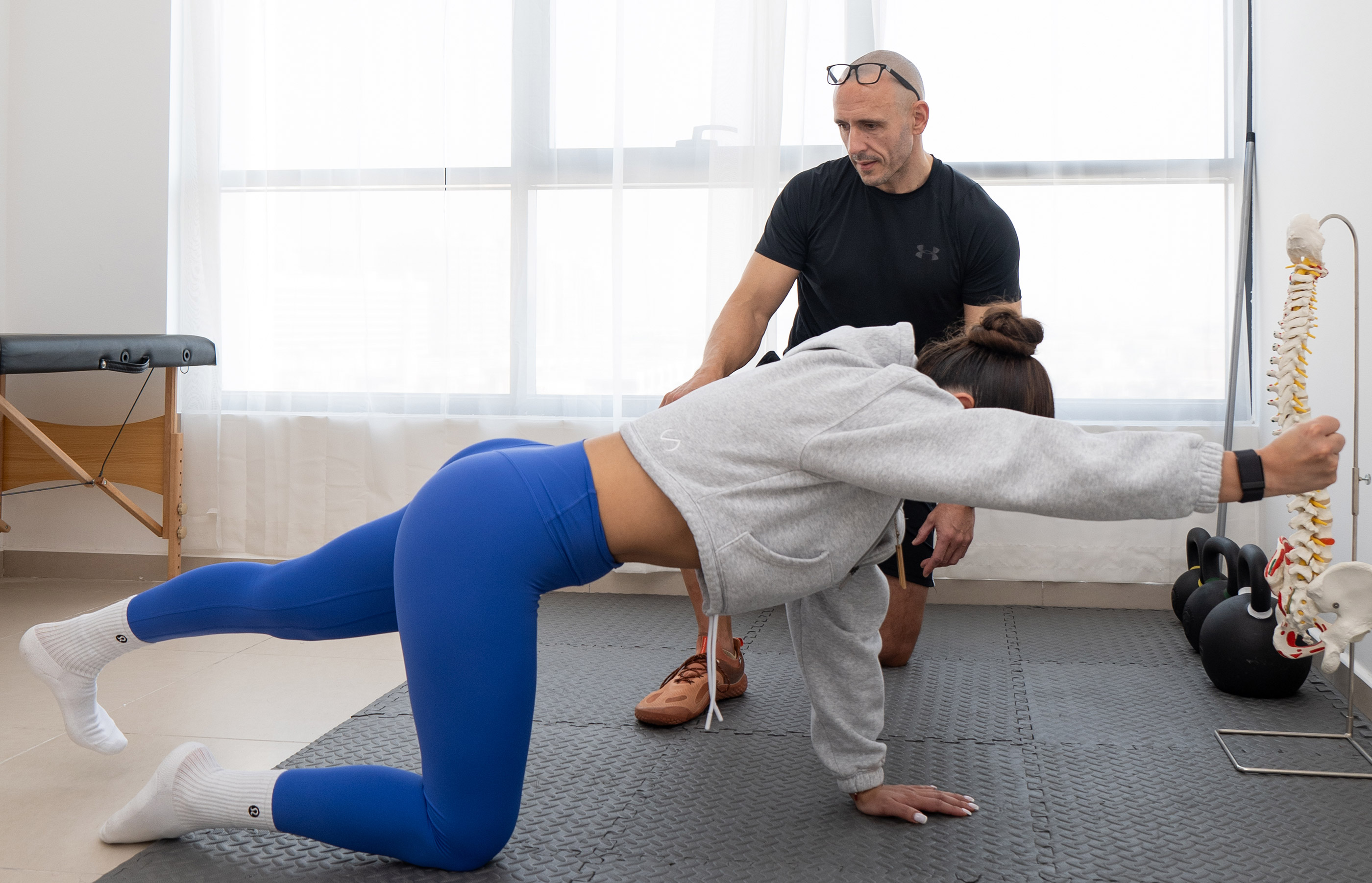
An assessment-led approach based on the work of Professor Stuart McGill, who spent more than 30 years researching spine biomechanics at the University of Waterloo. It starts with a detailed assessment of your history and how you move, using specific tests to identify which movements, postures and loads provoke your pain. The plan then focuses on removing or modifying those triggers in your daily life, building your back’s tolerance with targeted exercises, and progressing towards your goals, whether that’s sitting through a long meeting, picking up your children, or returning to the gym, golf or padel. Stress, sleep and lifestyle are taken into account, but they aren’t assumed to be the cause of your pain just because they’re present.
Who it suits
People with persistent or recurring back pain who’ve tried treatments without lasting results, people who’ve been advised to have injections or surgery and want to try the most conservative option first, people recovering from back surgery, and active people who want to return to sport or training.
When it makes sense
When your pain hasn't improved after treatment such as physiotherapy or chiropractic, when nobody has been able to explain the cause of your pain to you and when you’re ready to take an active role in your recovery.
Its limitations
It isn’t a quick fix or a hands-on treatment. It requires you to change how you move day to day and to follow your program consistently, which some people find harder than receiving treatment. It isn’t suitable for anyone with red flag symptoms, who needs medical assessment first, or for anyone looking for passive treatment.
The evidence and common misunderstandings
There’s no large randomised trial of the McGill Method as a whole, because back pain is a symptom, not a homogenous condition, a point Professor McGill has made for years. Studies that group everyone together as having “non-specific low back pain” and give them the same treatment can’t determine whether an approach built around each person’s individual pain triggers works.
Instead, the McGill Method draws on several kinds of evidence: laboratory research on how spines are injured, motion studies measuring the loads on the spine during movement, field studies with athletes, military personnel and other active groups, and clinical work with patients, including many who’d been told surgery was their only option. I explain this in more detail in Why evidence from pig spines is relevant to your back pain.
A common misunderstanding is that the McGill Method is the “McGill Big 3,” a well-known set of three core exercises. The method is in fact the assessment and the individualised plan that follows it. The Big 3 are just one set of tools that may or may not be part of that plan, and they should only be given to someone with back pain once the assessment has shown they’re appropriate for that person. So studies that give the same exercises to everyone, regardless of what’s causing their pain, are testing a one-size-fits-all approach the method was never designed to be. Their results tell you very little about the method, or about whether the exercises would help you.
What to ask
The same questions apply to me as to anyone else. Ask how I’ll identify your pain triggers and help you avoid provoking your pain, what you’ll be doing yourself, how we’ll measure progress, and what happens if you’re not improving. I’m happy to answer any additional questions you have during a free consultation.
A pattern I see often: someone with persistent back pain does a course of physio, perhaps six weeks or 10 sessions — whatever their insurance covers. The plan is fairly general: some exercises, some hands-on treatment and advice to stay active. When the sessions run out and the pain hasn’t improved, the next step they’re offered is a scan, then an injection, then a conversation about surgery.
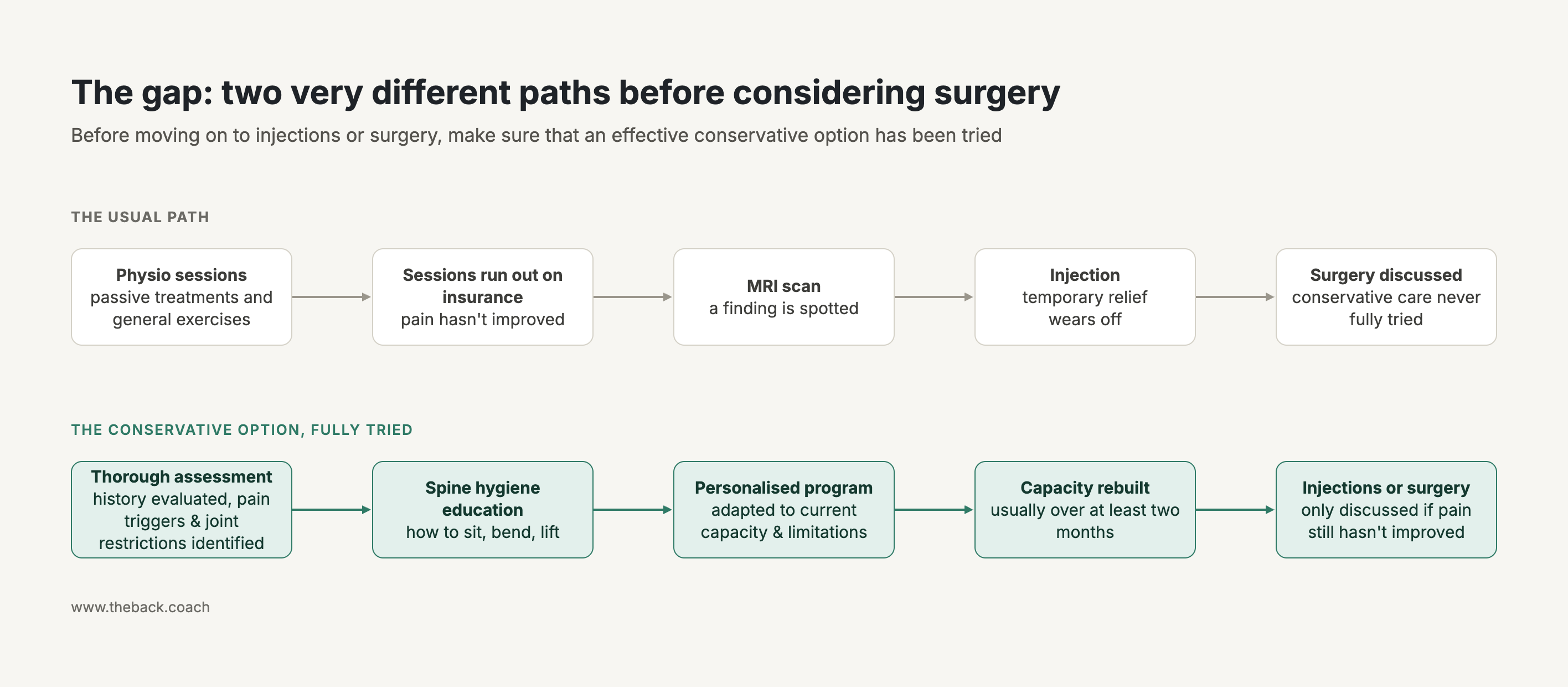
This usually isn’t the physio’s fault. Insurance limits, short appointments and busy clinics leave little time for the kind of detailed assessment persistent pain needs.
The problem is that the conservative option was never fully tried. A short, general program isn’t the same as a thorough, personalised plan, and not improving with one doesn’t mean the other won’t work. For sciatica, the research shows that people without worsening nerve symptoms who continue with conservative care generally end up with similar results to those who have early surgery, and many avoid an operation altogether (Peul et al., New England Journal of Medicine, 2007).
Before moving on to injections or surgery, it’s worth asking whether you’ve had a plan that:
If not, that’s the step I’d suggest trying first, whether with me or another practitioner who works in a similar way.
Dubai offers a wide range of alternative and specialist treatments for back pain. Here’s a brief summary of what the evidence says about the most common ones. If you try any of them, do it alongside an active plan that addresses your pain triggers, not instead of one.
Acupuncture and dry needling
Acupuncture has been studied extensively. Real acupuncture tends to do slightly better than sham (fake) acupuncture, but the difference is small, and guidelines disagree on whether to recommend it: the UK’s NICE guideline advises against it for low back pain, while the American College of Physicians includes it as an option. Dry needling, which targets tight spots in muscles, may reduce pain in the short term, but a review informing a World Health Organization guideline rated the evidence for needling therapies as low certainty, with little or no difference from comparison treatments for most outcomes.
Cupping (hijama)
A 2024 review of 11 trials found that cupping improved pain over the first two months of treatment, but results varied widely between studies, and it didn’t show a clear benefit for chronic back pain specifically. It may give short-term relief, but it won’t change what’s triggering your pain.
Ayurveda
There’s very little rigorous research on Ayurvedic treatments for back pain, and there’s a safety concern too: a study in JAMA found that about one in five Ayurvedic medicines bought online contained detectable lead, mercury or arsenic. Be cautious with herbal remedies, and tell your doctor if you’re taking any.
Osteopathy
Similar to chiropractic, using hands-on techniques such as mobilisation, manipulation and soft tissue work. The same evidence applies: NICE recommends considering manual therapy only as part of a package that includes exercise.
Spinal decompression machines
These are motorised traction tables, often marketed as an advanced alternative to surgery. A Cochrane review found that traction probably makes little or no difference to pain or function in low back pain, with or without sciatica, and NICE advises against offering it. Be wary of clinics selling courses of decompression treatment.
PRP and stem cell injections
Injections of concentrated platelets from your own blood (PRP), or of cells usually taken from your own bone marrow or fat, intended to help damaged tissue heal. They’re offered by doctors in Dubai, often marketed as an alternative to surgery, and are expensive and rarely covered by insurance. Reviews suggest they may help some people with pain coming from a disc, but most studies are small or have a high risk of bias, and claims that they “regenerate” discs aren’t well established. The most rigorously tested stem cell treatment for back pain is still in clinical trials and isn’t approved. If you’re considering them, ask what evidence supports them for your type of back pain, how many injections you’ll need, the total cost, and how you’ll know whether they’ve worked.
Shockwave therapy
Sound waves passed through the skin into the painful area. Reviews of small trials suggest it may reduce pain and improve function in the short term, over one to three months, but more rigorous research is needed.
Laser and infrared therapy
Reviews of low-level laser therapy disagree. The most recent high-quality review found its effect on pain and disability was too small to be clinically meaningful, although an earlier review suggested short-term benefits at higher doses. The evidence for infrared therapy rests largely on one small trial, and much of the online information comes from companies selling infrared devices.
Evidence reviewed November 2026.
“My back pain started recently, and I have no red flag symptoms.”
Many new episodes of back pain improve within a few weeks. Stay as active as you comfortably can, and notice which movements and positions make it worse. If you’re unsure what’s going on, see a GP. If it hasn’t settled within a few weeks, or keeps coming back, that’s the time for a thorough assessment of what’s triggering it.
“I’ve had back pain on and off for years, and nothing has lasted.”
This usually means your pain triggers have never been identified, so each treatment has given temporary relief while the cause stayed in place. In my view, the logical next step is a thorough assessment that identifies those triggers and teaches you how to avoid provoking them. That’s the focus of McGill Method assessment and coaching, but some physiotherapists work this way too. If you’d prefer to see a physio, use the questions in the physiotherapy section to find one who does.
“I’ve tried physio and it didn’t help.”
It’s worth asking what kind of physio you had. If it was a few sessions of general exercises and passive treatments, a truly conservative option hasn’t really been tried yet. See the gap between rehab and spinal injections or surgery.
“I’ve had an injection and the relief wore off.”
That’s common, because an injection calms irritation without changing what caused it. If you have another injection, use the pain-free window to work on improving your movement patterns and capacity, so the relief has a chance to last. See spinal injections.
“I’ve been told I need surgery.”
Unless it’s an emergency or your nerve function is getting worse, there’s usually time to get a second opinion and try a thorough conservative plan first. See surgery for the questions to ask.
“I have leg pain, numbness or tingling (sciatica).”
See a doctor if it’s severe or getting worse, especially if there’s any weakness. Otherwise, sciatica from a disc often improves with conservative care that teaches you to avoid the movements and positions that irritate the affected nerve. See spinal injections and surgery for when those become options.
“I have scoliosis.”
Your curve may or may not be causing your pain, since mild scoliosis is common and often painless. If it’s progressing or clearly contributing, see Schroth therapy. If not, your pain may have other triggers worth assessing.
Whichever option you choose, the most important thing is that someone identifies what’s actually triggering your pain, rather than treating the symptoms and hoping they don’t come back. For most people with persistent back pain and no red flag symptoms, that’s the most conservative step, and the one worth trying before injections or surgery.
If you’d like to find out whether my approach is right for you, start with the free 2-minute low back pain screen, or book a free consultation to talk through your situation. If I think something else would suit you better, I’ll tell you, and point you to someone I trust.